Super Fast and Delicious Tomato Bisque

Tomato Bisque with a Kick

Tomato Bisque with a Kick

After coming home to make dinner… I was kind of tired and wanted something quick. Well I didn’t realize how fast I could actually make dinner (under 7 minutes). It was a tomato bisque with a kick! You can make it without the serrano pepper too and it is great regardless. I topped the soup with a delicious garlic infused cashew sour cream, and YEAH!!! I actually made the sour cream first and put it in the freezer while I made the bisque. Then I didn’t even clean out the blender very well so I still had enough cashew cream to make the bisque nice and creamy. Add some cilantro on top because it is good for detoxifying and tastes great too!

Tomato Bisque

  • 1 -28 oz. can of organic diced tomatoes (I can’t wait until it’s summer for fresh tomatoes)
  • 1 cup water
  • handful of raw cashews (optional, but make creamier)
  • 1 Serrano pepper (optional for a kick)

Blend these up in a blender and then heat on stove until desired temperature. You can even add some fresh or frozen corn to give it more texture and a slightly sweeter flavor. I added corn because the serrano was a little too spicy for me.

Garlic-Infused Sour Cream

  • 1 cup raw cashews (soak them first if you don’t have a high-speed blender)
  • Juice of 1/2 lemon
  • 1 garlic clove
  • pinch of salt

If using a high speed blender add a little bit of water and blend until super thick and creamy (almost as thick as sour cream). Then put in freezer while heating up soup to thicken and spoon it on top. If using a food processor make sure to soak the cashews ahead of time (at least 4 hours… can even soak overnight for convenience) and only add water as needed. You may want to double this recipe to have some amazing sour cream on hand… keeps in refrigerator for about a week.

Fun Party Snack… Un-Tuna Pate

Untuna Pate

Un-Tuna Pate

Last weekend was my nephew’s 1st birthday and I wanted to make some healthy and fun party snacks. Of course they are gluten-free and vegan, and even my mom thought they tasted like tuna. I never really know about such things since I haven’t had tuna in almost 20 years, but I was happy they were a crowd pleaser. They were super easy to make as well!

Un-Tuna Pate

  • 2 cups sunflower seeds (soaked at least 4 hours or overnight)
  • juice of 1 lemon or lime
  • 1-2 garlic cloves
  • 1/4 cup finely chopped onion
  • 1 cup finely chopped celery
  • 1/2 cup finely chopped parsley or cilantro
  • salt and pepper to taste
  • other herbs to try: dill, celery seed, chipotle, oregano… whatever inspires you!!!

Pulse garlic and onion in food processor until finely chopped. Then pour off the water you soaked the seeds in and add them to the food processor with the lemon juice and pulse until you get the consistency you want (you may even want to add a little water if you are looking for a creamier consistency). I made mine chunky so the appearance was more tuna-like. Transfer contents into a mixing bowl and add the chopped celery, parsley, salt, pepper and any other herbs you’d like. One tip to making it even more fishy is adding some seaweed… a sheet of nori works really great.

Then I added a small dollop on square cut pieces of romaine lettuce… you can use chard, collard greens, seaweed as a healthy and beautiful way to serve these. Top with some spiralized or shredded carrot and ENJOY!!!

Who Needs Coffee When You Have GREEN SMOOTHIES!!!

I have been absolutely loving GREEN SMOOTHIES! I used to make them all the time and when I would try to share them with someone… well let’s just say it wasn’t the most palatable experience. But now after reading Green Smoothie Revolution by Victoria Boutenko, the smoothies I make are amazing and other people love them too. So the smoothies I used to make were out of spiralina, wheat grass, kale, maybe an apple. Yes they are good for you, but they tasted a lot like a grass smoothie.

It was actually my brother who said he was reading Green Smoothie Revolution, and actually making the smoothies and liking them. He had better energy and digestion from consuming 1-2 quarts of green smoothies/day. I had heard of this book before and I just assumed that it would be more of my crazy super green smoothies that tasted a bit too green. So I borrowed his book and actually followed some of the recipes and… WOW!!! So delicious, so fruity, still a beautiful green color (at least the recipes that don’t have blueberries or beet greens), and I keep wanting more. I have been consuming green smoothies every day for the past 2 weeks and I can tell you, even living on the Oregon coast with the lack of sunshine my energy is better than if I were having a couple shots of espresso!!!

Today the green smoothie I made (pictured below):

  • 1 mango
  • 1 banana
  • 2 cups spinach
  • 2 large kale leaves
  • 1 or 2 cups water (enough to blend up)
Green Smoothie

Green Smoothie for Today!!!

Some tips for making delicious GREEN SMOOTHIES:

  • rotate greens (meaning use different greens every couple days: maximizes nutritional value)
  • use fruit high in soluble fiber (this makes smoothie homogenous in texture and prevents separation)
  • drink 1-2 quarts/day (increases energy: can even be used as a meal replacement)
  • remember greens have the most protein/cal of any food so you will be getting all the protein you need
  • experiment to find recipes that you love!!!
  • check out Green Smoothie Blog for more recipes and ideas

Spring Cooking Class Series

It has been quite a while since the last cooking class… so I am excited to be starting up again! Since I got to spend some time in Bali I thought it would only be appropriate to make some great Balinese cuisine. The most popular dish I saw and consumed in Bali was Nasi Campur (mixed rice). Sounds simple enough, but you would not believe the presentation of this dish at some of the local warungs (small cafes). Basically it involves rice with veggies, tempeh, and sambal, a hot mix of chiles and garlic for those who like it spicy! My favorite restaurant in Bali, Warung Sopa was in Ubud, more of the cultural center of Bali… lots of beautiful rice patties and artwork. I especially loved this restaurant because you got to choose which veggie and/or tempeh or tofu dish you would like in your nasi campur.

So my cooking class for April is going to be Balinese themed… we will be making Nasi Campur, with seasonal greens and tempeh or seasoned soy curls as sides. Of course there will be sambal to light our digestive fire. For dessert is a pudding made out of chia seeds and freshly made coconut milk with bananas on the top! The dessert is actually inspired by Ani Phyo, from her Ani’s Raw Food Asia book. Chia seeds are even more packed with omega-3’s than flax seeds!!! The cooking classes are on Thursday, April 5th and Tuesday April 17th. Go to my website to see the cooking class schedule for more info. As always the Creative Healthy Cooking Classes are vegan and gluten-free!

vegan nasi campur

vegan nasi campur

List of Indonesian Foods that are Traditionally Vegan and Gluten-Free

Gado Gado (steamed veggies and tempeh with peanut sauce) at Sanur Beach, Bali

Gado Gado (steamed veggies and tempeh with peanut sauce) at Sanur Beach, Bali

 Here is a list of some traditionally vegan and gluten-free recipes found in Indonesia. Many dishes are already gluten-free due to much use of rice, mung bean or tapioca flour over wheat flour. But you still have to watch out for soy sauce in dishes for flavor. The main non-vegan item in Indonesian cooking is chicken stock in rice and noodle dishes as well as shrimp paste that is used for flavoring many savory dishes. The dishes listed below don’t traditionally have either of those non-vegan ingredients or contain gluten (unless otherwise noted). The recipes for the dishes I have listed found from  www.indonesianfoodrecipes.com, a very helpful website for recipes on how to make many traditional dishes. I love all the desserts made from glutinous rice (this rice does not contain gluten, it just has that name because it is sticky). Glutinous rice is also called sweet sticky rice or mochi rice, since it is the rice that mochi is made out of… one of my favorite desserts!

 This is not a complete list by any means and of course any restaurant or chef may have a different version of these recipes, I just thought it was a good place to start.

Vegan and Gluten-Free in Sanur Beach, Bali

Nasi Campur

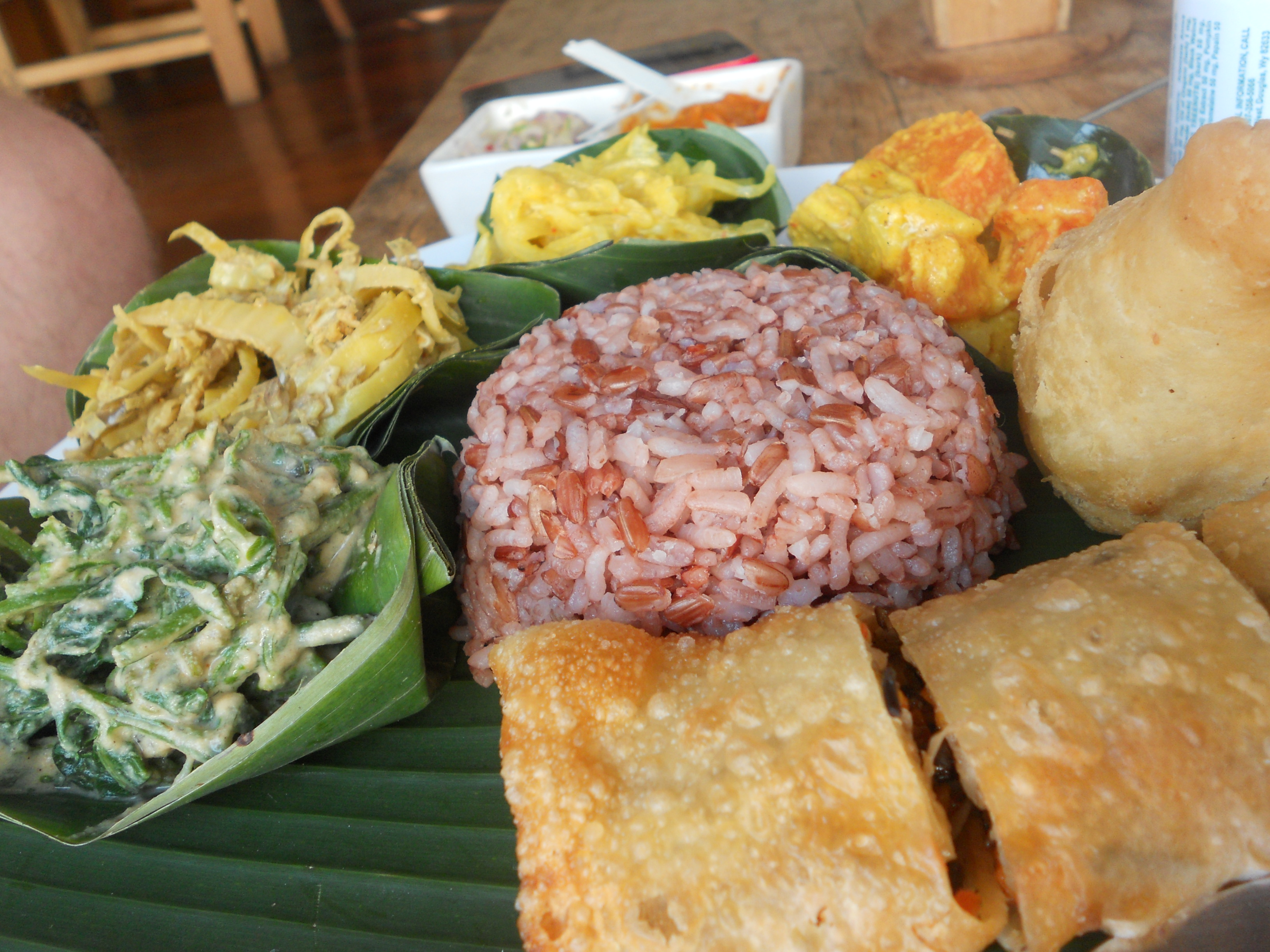
Vegan and Gluten-Free Nasi Campur at Manik Organic in Sanur Beach

I found a restaurant called Manik Organik that used to be completely vegetarian (now they serve fish and chicken) in Sanur Beach. This is the only place I have seen acknowledging gluten-free and vegan on any menu in Sanur… and trust me, I have been looking. Most of our time in Bali so far has been walking around and taking it easy to get plenty of rest for our adventures to come. The only other place I have seen that has the word vegetarian on the menu is at Bonsai Cafe (right on the Sanur Beachfront).  Anyway I was so happy to find this place again via happycow.net.

I tried the nasi campur, which was labeled vegan and gluten-free. It was delicious and seemed very traditional Balinese cuisine, served on a banana leaf. There was a mountain of brown rice and spicy sombal coated tempeh and tofu. With a green bean, water spinach, and sprouted vegetable dish (this was really tasty since it has some toasted coconut mixed in… both savory and sweet) and some tempeh and tofu kabobs. They have a great selection of juices too. I had the carrot, apple and parsley blend. Our next stop is Seminyak, Bali which apparently has lots of vegan and gluten-free options. More to come!!!

Drinking some fresh juice with a bamboo straw

Drinking some fresh juice with a bamboo straw

Great Food in San Francisco

Curry Dish at Herbivore in San Francisco

Curry Dish at Herbivore in San Francisco

Before our 20 hour flight to Bali we had a nice long layover in San Francisco… one of my favorite cities! The problem there is not the lack of vegan restaurants, but the hard choice of which one to eat at. We decided to go to a restaurant called Herbivore. I had a nice curry dish and Dan had a shepherd’s pie with a ton of sauteed kale. I was kind of jealous when I saw his pile of kale, but of course being the sweetheart he is, he shared it with me.

We are now in Bali, but have not yet found a vegan restaurant. There is a ton of fresh fruit and vegetables so we are having no problem with food, but I am excited to go to one of the restaurants I found on happycow.net. We are staying at Sanur Beach, but soon will be venturing forth to find a great vegan / gluten-free restaurant. Once we find one I will be posting some reviews and more about our adventures in Indonesia.

Great Article on Reducing Allergies with a Vegan/Vegetarian Diet

This article is a repost from the Southern Vegan Blog, this is a fun vegan blog that I have been following. It is inspirational and lots of great recipes. This is not a gluten-free blog, but so far it looks like many of the recipes can be easily converted. I love this article and basically any book that Neal Barnard, MD writes. He is the president of the Physicians Committee for Responsible Medicine and author of Dr. Neal Barnard’s Program for Reversing Diabetes and 21 Day Weight Loss Kickstart: Boost Metabolism, Lower Cholesterol, and Dramatically Improve Your Health.

“Diet Changes Help Allergies That Flare Up in the Spring and Fall

Source: Dr. Neal Barnard; The Vegetarian Times

Nutrition plays a major role in asthma, and there’s increasing evidence that foods can affect seasonal allergies too. When you have asthma, your bronchial tubes constrict, which causes wheezing, chest tightness and difficulty breathing. If you have it, you’ve no doubt found that attacks can be triggered by allergens such as pollen, as well as by infections, stress, cigarette smoke and other factors.

For many years, people with asthma suspected that dietary changes might help. Many noticed that they had fewer episodes and needed less medication when they switched to vegetarian (especially vegan) diets. In the mid-1980s, anecdotal reports led researchers to put these observations to the test. In a one-year study, they found significant improvements in lung function and a major reduction in medication use when patients switched to a vegan diet. Then in 1994, investigators at Loma Linda University tracked how often medical treatments for ailments, including asthma, were needed in a group of nearly 28,000 people. Vegetarians were less likely to need treatment for asthma—females were even less likely than males.

Why do vegetarian and vegan diets help? Researchers first attributed these benefits to the absence of common food triggers, such as meat, dairy and eggs. After all, if you’re not eating troublesome foods, you can’t have an allergic reaction to them. But there’s probably more to it. Repeated studies have shown that people who eat more fruits and vegetables have reduced risk of asthma, presumably because these foods improve immune system functions.

Vegetarians are also thinner, which is surprisingly important in asthma. Harvard’s long-term Nurses’ Health Study (an ongoing project studying thousands of nurses for multiple health concerns) found that thin people have only one-third the risk of asthma compared to overweight participants. When heavy people begin a low-fat, vegetarian diet, they typically lose a significant amount of weight, which is likely to improve asthma.

One note of caution: A vegetarian diet does improve nutrition and help alleviate asthma, but it’s also possible to be allergic to some vegetarian foods, such as peanuts, soy or wheat.

If seasonal allergies trigger asthma for you, or if they leave you with itchy eyes and a runny nose, here are two nutritional additions to consider:

Vitamin E

Whether it comes from foods or supplements, vitamin E seems to help ward off seasonal allergy symptoms. You’ll find it in green leafy vegetables (spinach, kale, etc.), beans, apples, carrots, celery, wheat germ and nuts. Researchers suspect that vitamin E stops your immune system from overreacting to pollens or other allergens.

Butterbur

(Petasites hybridus, also called butterdock) is an herbal remedy that has been used for centuries to soothe respiratory complaints. For symptoms of seasonal allergies, it works surprisingly well. Butterbur proved as effective as the antihistamine cetirizine (Zyrtec) against seasonal allergy symptoms, reported a Swiss study published in 2002 in the British Medical Journal. And although antihistamines are sedating, the herbal treatment isn’t.

Nutritional factors may even help prevent allergies. In a three-year Italian study in the 1990s, new mothers breast-fed their infants and didn’t introduce commonly allergenic foods such as whole cows’ milk, eggs, fish and nuts during the child’s first year. They also limited dairy products and avoided eggs in their own diets. These simple steps in the first years of their babies’ lives dramatically reduced the likelihood that the children would develop allergic symptoms later.

Although we may not be able to eliminate asthma and allergies entirely, diet changes can clearly help. And if started early enough, they can help children avoid a great deal of misery.

Chocolate Avocado Pie

Chocolate Avocado Pie

Chocolate Avocado Pie

This is a classic pie that I originally modified from a vegweb recipe. This pie actually has quite a funny story to go with it, but the taste is nothing to laugh at. The story first… my family doesn’t like avocado, and my mom asked me to make a pie for Thanksgiving 5 years back. I come from a family of chocoholics, so when I stumbled upon a chocolate avocado pie I could not resist the temptation into tricking my family into eating avocado. The crazy thing was I never expected the pie to taste so good!!! Extremely rich like a chocolate torte, and if you add more melted chocolate into the mixture, it is even truffle-like. I was very surprised when my family wanted seconds, and only then did I reveal its avocado secret. Now I get requests for this pie all the time. Here is the recipe… so very simple and quick it really shouldn’t taste as good as it does…

Chocolate Avocado Pie

Filling:

  • 2-3 ripe avocados (depending on size)*
  • 1 bag of chocolate chips (check label to make sure no dairy ingredients)

Crust:

Raw version:**(gluten free)

  • Raw almonds, or any raw nuts, dates, agave, salt

Make crust by using food processor or chopping nuts and dates by hand.  The crust needs to stick together when pressed into an oiled pan.

Baked version: (contains gluten)

  • Pre-make a flour or graham cracker crust.

Bake and let cool before putting filling in.

Directions:

Use a double boiler to melt bag of chocolate chips.  (Can also just use raw cacao nibs and agave with vanilla if you want to make this pie truly raw). Blend avocado until creamy and smooth in blender, mixer or food processor. Stir avocado into melted chocolate. Pour into crust and refrigerate until pie is set, at least 3 hours.

*For creamier consistency use more avocados, for richer consistency more like a truffle use less avocado and more chocolate.

**Crust can be made from any variety of nuts, for example: coconut and almond; pecan and dates, with a hint of cinnamon. Then press into oiled pie pan. Be creative and use what inspires you!!!

My cat trying to get a piece of the pie...

My cat trying to get a piece of the pie...

Three Reasons to Eat Turmeric – Dr. Weil

This is a re-post of Dr. Weil’s article since it has such relevance to my last post and I love his work…
3 Reasons to Eat Turmeric

1 turmeric inside

Turmeric (Curcuma longa) is a culinary spice that spans cultures – it is a major ingredient in Indian curries, and makes American mustard yellow. But evidence is accumulating that this brightly colored relative of ginger is a promising disease-preventive agent as well, probably due largely to its anti-inflammatory action.

One of the most comprehensive summaries of turmeric studies to date was published by the respected ethnobotanist James A. Duke, Phd., in the October, 2007 issue of Alternative & Complementary Therapies, and summarized in the July, 2008, issue of the American Botanical Council publication HerbClip.

Reviewing some 700 studies, Duke concluded that turmeric appears to outperform many pharmaceuticals in its effects against several chronic, debilitating diseases, and does so with virtually no adverse side effects. Here are some of the diseases that turmeric has been found to help prevent or alleviate:

  • Alzheimer’s disease: Duke found more than 50 studies on turmeric’s effects in addressing Alzheimer’s disease. The reports indicate that extracts of turmeric contain a number of natural agents that block the formation of beta-amyloid, the substance responsible for the plaques that slowly obstruct cerebral function in Alzheimer’s disease.
  • Arthritis: Turmeric contains more than two dozen anti-inflammatory compounds, including sixdifferent COX-2-inhibitors (the COX-2 enzyme promotes pain, swelling and inflammation; inhibitors selectively block that enzyme). By itself, writes Duke, curcumin – the component in turmeric most often cited for its healthful effects – is a multifaceted anti-inflammatory agent, and studies of the efficacy of curcumin have demonstrated positive changes in arthritic symptoms.
  • Cancer: Duke found more than 200 citations for turmeric and cancer and more than 700 for curcumin and cancer. He noted that in the handbook Phytochemicals: Mechanisms of Action, curcumin and/or turmeric were effective in animal models in prevention and/or treatment of colon cancer, mammary cancer, prostate cancer, murine hepatocarcinogenesis (liver cancer in rats), esophageal cancer, and oral cancer. Duke said that the effectiveness of the herb against these cancers compared favorably with that reported for pharmaceuticals.

How can you get more turmeric into your diet? One way is via turmeric tea. There are also extracts in tablet and capsule form available in health food stores; look for supercritical extracts in dosages of 400 to 600 mg, and take three times daily or as directed on the product.

And, of course, one can simply indulge in more curried dishes, either in restaurants or at home. However you do it, adding turmeric to your diet is one of the best moves toward optimal health you can make.

Related Topics
Healthy Turmeric Tea

Three Reasons to Eat Turmeric – Dr. Weil.